
Reed Hundt Keynotes AEI Conference on the 1996 Telecom Act – Feb. 10th, 9 AM ET
Editor’s Update: Here is a copy of Reed’s speech: AEI.Eval of 1996 Telecom Act
If you look at the horizon, you’ll see a tsunami of technological change rising in an incredible wave of disruptions — artificial intelligence, quantum computing, decentralized finance, robotics, and bioengineering. From the commercialization of space to brain implants and deepfakes that feel pulled straight from The Matrix, the pace of change is staggering.
As if the speed of innovation weren’t enough to overwhelm us, our society is also facing an epistemological breakdown—a reality in which there is no longer a shared truth to serve as the foundation for collective discussion and decision-making.
What to do about it?
The public conversation usually splits into two camps: the “doomers” and the techno-optimists, both predicting utopian or dystopian outcomes. When these subjects come up in Yale 1969 discussions, the refrains are similarly conflicted:
“I’ll be dead soon, so I don’t need to worry about this.”
“But my kids and grandkids—I really, really worry about them.”
We care deeply, but there is a pervasive sense of resignation. However, history may offer some guidance about what can happen from here, and that’s the subject of an AEI conference tomorrow, where our own Reed Hundt is the keynote speaker.
Grand Strategy and Telecommunications Policy in the 1990s
Topic: Reed Hundt – 30 Years of the Telecommunications Act: What Did We Learn?
Time: Feb 10, 2026 09:00 AM Eastern Time
Join Zoom Meeting
https://aeimeeting.zoom.us/j/86453759130
Meeting ID: 864 5375 9130
—
One tap mobile
+13017158592,,86453759130# US (Washington DC)
+13052241968,,86453759130# US
– author
We faced a remarkably similar set of disruptions in the 1990s. Back then, the catalysts were wireless telecommunications, cable TV, internsatellites, and fiber optics. The regulatory hodgepodge of the 1930s was breaking down, and a new world order was emerging after the fall of Communism.
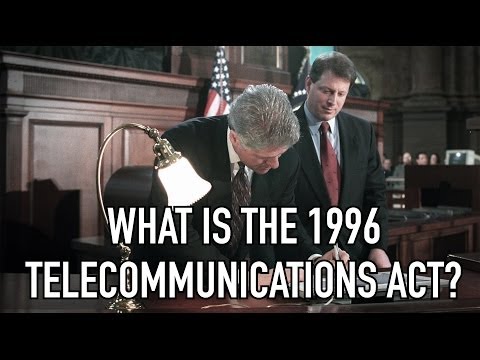
In the center of that storm, the Clinton-Gore administration and their FCC Chairman—our own Reed Hundt—developed a “grand strategy” for a new regulatory regime. That strategy became the Telecommunications Act of 1996.

You’re Invited: A Keynote by Reed Hundt
Tomorrow, the American Enterprise Institute (AEI) is holding an all-day conference to evaluate what worked and what didn’t in that landmark law. The goal is to extract lessons that can inform the public policies we need today to manage this current wave of disruption in the public interest.
Reed will be delivering the opening keynote, and he has personally arranged for our class to be invited to the live stream.
When: Tomorrow, Feb 10, at 9:00 AM ET
Where: Live-streamed (See the attached calendar invite for the link)
Resources: For those who cannot attend, Reed has provided a copy of his paper for preview.
Let’s move past resignation. By looking at how we successfully navigated the digital revolution of the 90s, we may find the tools to help our children and grandchildren navigate the one happening now.