Seltzer: Voices of the Owned
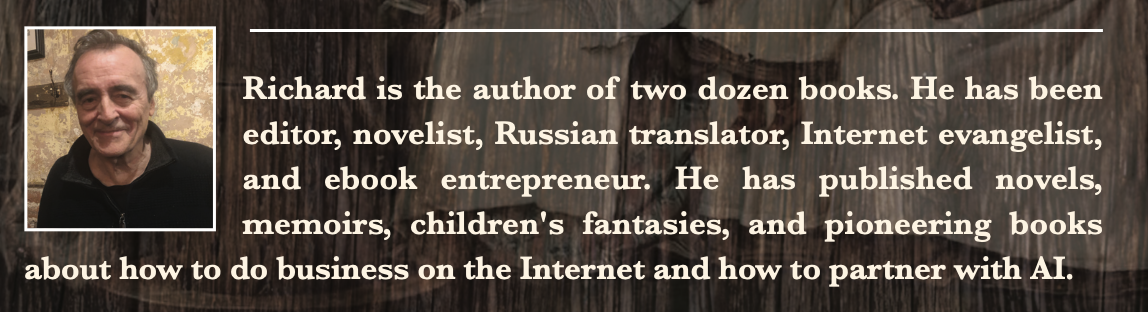
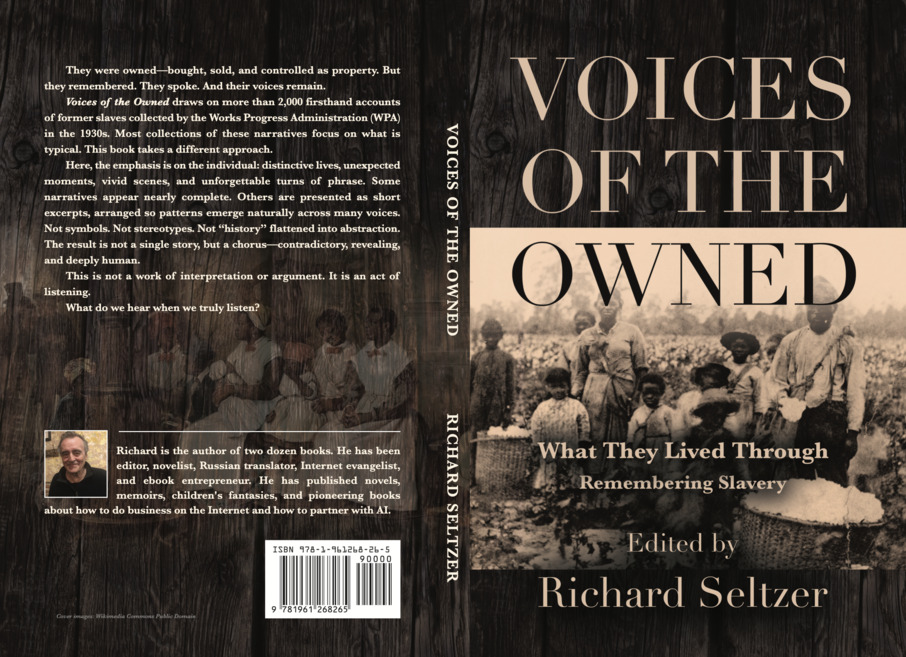
Our prolific classmate, Richard Seltzer, has delivered another important work — Voices of the Owned. This work draws on more than 2,000 firsthand accounts of former slaves collected by the Works Progress Administration (WPA) in the 1930s.
Most collections of narratives like these focus on what is typical. This book takes a different approach– a focus on the individual: distinctive lives, unexpected moments, vivid scenes, and unforgettable turns of phrase.
You can buy the book on Amazon, or less expensively on Barnes and Noble, but Richard is making the PDF available free to classmates. Just download it here. “I’m interested in readers, not sales,” Richard says. “Please encourage them to forward it to others. (At our age, what’s the point or fame or fortune?)”
Richard started with a single document of all 2,000 interviews — over two million words! He then developed an “AI Partner” to help him choose with narratives to highlight — a process he describes in a personal PS to Yale ’69:
The role of Simon, my AI partner:
Simon didn’t write the book or generate any of the narratives. The voices are entirely those of the former slaves interviewed for the WPA project.
His role was closer to that of a research and editorial partner. He helped to sift repeatedly through the massive original document, as we identified a few hundred candidate interviews out of the 2200 total, those I could read in detail, and decide which were the most interesting, memorable, and emotionally engaging. Then I sought to juxtapose them in interesting ways, bringing out the contrasts without explaining them. I made the decisions and did the editing. The former slaves and their interviewers did all the writing.
I worked from a single master document containing over 2,000 slave narratives — 2 million words. Instead of approaching that corpus statistically or academically, I used AI collaboratively to help identify distinctive voices, unexpected patterns, thematic clusters, anomalies, and possible structural relationships across the archive. I wasn’t looking for evidence of some preconceived notion. I wasn’t looking for what was typical or average. I was looking for what was unexpected, what didn’t neatly fit into categories.
Simon helped identify candidate narratives:
- surfacing unusually vivid or stylistically distinctive speakers,
- comparing possible groupings and sequencing,
- testing structural alternatives,
- identifying surprising contrasts,
- helping trim and shape excerpts while preserving the individuality of each voice.
The editorial judgments — what to include, how to structure it, what to cut, and what the book ultimately means — were mine.
In a sense, the project became an experiment in whether AI could help a human editor/listener engage more deeply and attentively with a massive body of historical human testimony rather than flattening it into summaries or statistics.
That’s why I call it a proof of concept.
Here’s an informal personal explanation of how and why I did this, including a personal connection to one of the slave narratives.
I had known about the WPA Slave narratives for over 20 years, My late wife had assembled the 35 separate files of the original into a single searchable file which we published as an ebook (selling for 99 cents), trying to make these accounts accessible to all, rather than just to experts. I wanted to do something more with them; and now with some help from AI, I was able to identify unique voices amid the noise — not to arrive at generalities, statistics, summaries, and images of what was typical — to hear individual, sometimes contradictory, sometimes powerful voices that had been buried in noise for 90 years.
Another book of mine (One Family), along with anecdotal memoirs and reflections on much of human history, recounts the tangled tale of my mother’s father, Smith William Estes. He was a second cousin of Senator Estes Kefauver of Tennessee and also a descendant of plantation owners and slave owners in west Tennessee.
Mom was raised in Philadelphia as an orphan by unmarried sisters of her deceased mother. She didn’t know that her father had family in Tennessee. She was trained to tell everyone that her father was dead, to hide the fact that he was in prison, serving a long sentence for having molested her younger sister and other young children. She didn’t find out about her father’s family until she was 36 in 1956, when Estes Kefauver was running for vice president (with Adlai Stevenson). Because his first name was “Estes” and her maiden name was “Estes”, she wrote to him wondering if they might be relatives. He replied that they were in fact cousins and pointed her to a family genealogy book where her birth was recorded. I was ten at the time and knew nothing about any of this. A few years later, Mom told me the story (what she knew of it) because she thought that I might one day run for political office (maybe even president), and she didn’t want me to be blindsided by revelations about her father.
By chance, immersing myself in the original WPA narratives, I came across Mary Estes Peters. Her father was a white slave owner named “Estes” and she herself was enslaved. She was born in Missouri near the Mississippi, near the plantation of my Estes ancestors in Tennessee near the Mississippi. She was probably a cousin of mine.