
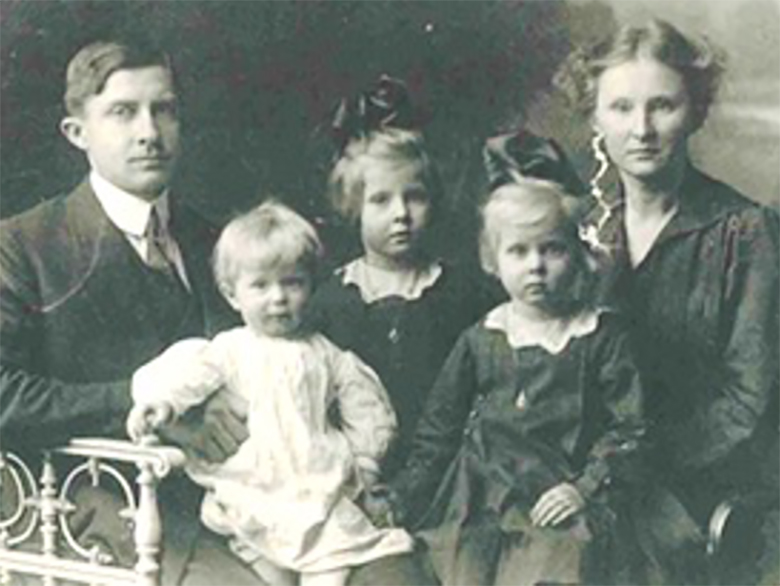
Ted Van Dyke is published in academic history journals
What actions should you consider upon learning that your grandfather was like Reuben Markham—a missionary, educator, journalist, intelligence officer, and a significant American figure who played a vital role in the social and political lives of pre-war Bulgaria? What steps should you take when research reveals a wealth of historically important actions and writings associated with his life?

Markham was a truly remarkable man. See this interview Ted Van Dyke gave to Kultura, the Bulgarian “Portal for Art and Culture” about Markham. (English translation)
Markham, the author of nine books, had quite the journey: from missionary and teacher to journalist covering the Balkans and Central Europe for the Christian Science Monitor in the 1920s and 30s to intelligence officer in World War II and the early Cold War. It’s a story replete with intrigue, courage and moral fortitude.
Should you simply share his story with the family? Maybe you could compose a casual piece for relatives and friends? Or do you decide to adopt a more formal and serious approach… for history?
Well, if you’re like Stuart (“Ted”) Van Dyke, you dust off your PhD in European History, ignite your research skills, and dive into the archives of the US State Department, the Christian Science Monitor, and several Bulgarian and other primary sources. You seek to uncover exactly what your grandfather did and how his contemporaries responded. And with a scholar’s dispassionate eye, you document that for history.
The result of the research reveals some astonishing details; the story may become a book. But, in the meantime, and because Ted documented things so precisely, serious academic journals were interested in publishing “chunks” of Markham’s story.
The Bulgarian Historical Review published an essay about some key events in the 1920s. See “Stuart Van Dyke Jr.. “American Missionary/Journalist Reuben Markham’s Response to Bulgaria’s 1923 Coup and Its Aftermath.” As this abstract summarizes, this report on Markham’s career goes much further than just this event in 1923:
Abstract: Reuben Markham was an American missionary-educator sent to the American Boys’ and Girls’ Schools in Samokov in 1912. An inspiring teacher, he returned to the United States in 1918 carrying secret Bulgarian government documents to persuade America to refrain from declaring war. Back in Bulgaria in 1920, he focused on journalism, editing several Bulgarian language periodicals. He criticized the Stambolisky government’s use of violence, then, after the 1923 coup, exposed the regime’s extrajudicial killings. He also helped many Bulgarians, regardless of political affiliation, either flee, reduce their sentences or be released from prison. His actions led the government to force his resignation from the American mission in 1925 and to arrest and try him in 1927. In 1931, Markham published his well-regarded Meet Bulgaria. Returning to the United States in 1939, he continued his opposition to authoritarian governments, first against Nazi Germany, and then after World War II, the Soviet Union’s domination of Eastern Europe. Using newspaper stories from the 1920s, descriptions of Markham, his personal letters and American archival sources, this article provides new information about Markham’s life, his teaching, his descriptions of government killings and his assistance to those in danger during this tumultuous period.
Serbian Studies is the peer-reviewed journal of the North American Society for Serbian Studies. The journal just published an article about Markham that addresses a crucial event in 1944, when Markham resigns to protest U.S. support for Tito. Again, the Abstract gives the bigger picture:
Abstract: Reuben Markham, [Office of War Information] Deputy Director for the Balkans, spent 1944 in Cairo and Bari, Italy. Described as America’s best-informed Balkan expert, he believed the Partisan leaders were committed Communists planning to install a dictatorship. Although recognizing the shortcomings of the interwar regime and Chetnik collaboration, he respected Yugoslavia’s contribution to the Allied war effort and was horrified by the massacres against the Serbs. He favored Mihailovitch to prevent a Communist takeover, not believing the Partisan military contribution merited supplying Tito exclusively, while making the Allies complicit in its victory. His arguments against supplying the Partisans reached the highest levels and he helped the August OSS mission to assist the Chetniks. When these efforts failed, he resigned in October 1944. Through his journalism and his 1947 book Tito’s Imperial Communism, he publicly presented his positions, based on his life-long experience, his personal involvement, and his wartime access to classified information.
Diplomacy and Statecraft is an international, peer-reviewed journal that addresses diplomatic history, recently declassified documents, and memoirs from former diplomats. It recently published one of Ted’s essays about Markham: Russia’s 1946 Expulsion of Journalist Reuben Markham from Eastern Europe. Its interest (and the scope of this article) is summarized in the Abstract:
Abstract: Bulgaria and Romania’s futures were still to be decided at war’s end, but, until Potsdam allowed them in, Western journalists had been prevented from entering these countries, restricting first-hand accounts of Soviet activity. Reuben Markham had spent most of his adult life in Bulgaria, first as a missionary-educator and then as a correspondent for the Christian Science Monitor. Using letters, newspaper accounts, and archival resources, this article analyses his assignment in Eastern Europe from August 1945 to June 1946, when the Russians expelled him because of his reporting and influence on local democratic leaders. During this period, American public and official opinion changed from being favourable to the Soviet Union to becoming apprehensive about its actions. Markham knew the Balkans better than any other American journalist and his entry was pushed by the White House. At its request, he submitted a report about Bulgaria, which, along with diplomatic cables and the Ethridge Mission, informed the President’s thinking. Markham had family ties to Ethridge’s assistant, Cyril Black, criticised Bulgaria’s November election and chronicled Romania’s failure to guarantee political freedom, with his reporting putting him in personal danger. Acheson labelled his expulsion a violation of the Potsdam Declaration. In July, Markham urged the US to resist Soviet expansion, counselling Truman personally in an August meeting, which coincided with the Administration’s firm stand to counter Russian encroachment on the Turkish straits. Markham’s work placed him in the vanguard of Americans who identified and acted upon the Soviet Union’s increasing control of Southeastern Europe.
Ted says that all of this research might become a book. But, in the meantime, he is happy that Markham’s story is getting some attention, especially in Bulgaria. Ted can be reached at tvandyke1948@gmail.com.